
Production and Fuel Property Characterization of Biodiesels from Waste Swine Oil and Waste Cooking Oil
DOI:
https://doi.org/10.54327/set2026/v6.i2.336Keywords:
Biodiesel, Waste swine oil, Waste cooking oil, Transesterification, Fuel properties, Cetane number, Purification and Waste-to-fuelAbstract
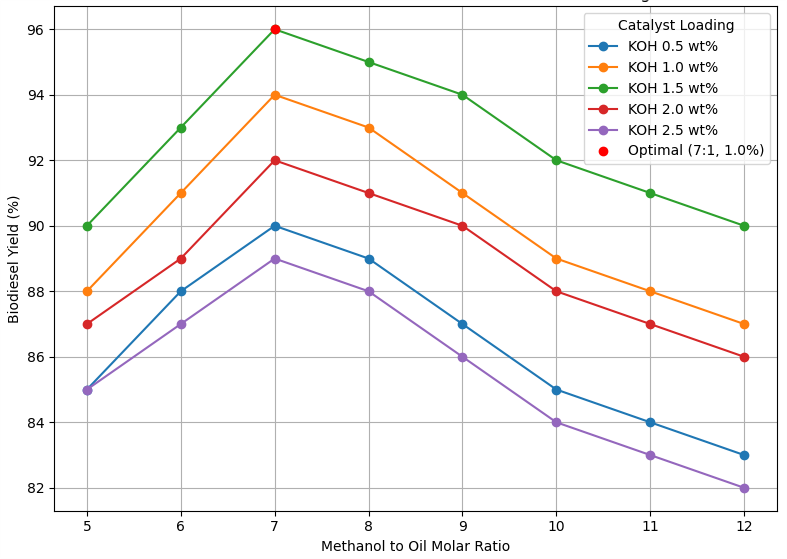
Biodiesel fuels were produced from waste swine oil (WSO) and waste cooking oil (WCO) and evaluated in terms of fuel properties, blend characteristics, and purification requirements. The WSO feedstock had an acid value of 0.54 mg KOH/g and an FFA content of 0.27%, indicating low free fatty acidity and allowing direct base-catalyzed transesterification without acid esterification pretreatment, while the higher-FFA WCO required acid esterification. Transesterification was investigated over methanol-to-oil molar ratios of 5:1–12:1 and KOH loadings of 0.5–2.5 wt.%, with 7:1 and 1.0 wt.% KOH selected as the optimum conditions. The biodiesels generally satisfied the evaluated ASTM D6751 requirements. WSO biodiesel contained 96.4 wt.% FAME, marginally below the EN 14214 minimum of 96.5 wt.%, while WCO biodiesel achieved 97.2 wt.%. WSO biodiesel exhibited a cetane number of approximately 65, viscosity of 5.9 mm²/s, density of 886 kg/m³, and cloud point of 14 °C, consistent with its higher saturated FAME content. WCO biodiesel exhibited a cetane number of approximately 54, viscosity of 4.7 mm²/s, density of 880 kg/m³, and improved low-temperature properties, with a cloud point of approximately 2 °C. GC–MS analysis showed that WSO FAMEs were predominantly C16:0 and C18:0, while WCO contained higher proportions of C18:1 and C18:2. ULSD blends from B20 to B80 showed improved lubricity, higher flash points, and lower sulfur levels, while calorific value decreased with increasing biodiesel content. These findings demonstrate the viability of WSO and WCO as biodiesel feedstocks, with WSO providing higher ignition quality but requiring more intensive post-reaction purification and washing.
Downloads
Downloads
Published
Issue
Section
Categories
License
Copyright (c) 2026 Olufisayo E. Ojo, Riaan Stopforth

This work is licensed under a Creative Commons Attribution 4.0 International License.
Authors are permitted and encouraged to post their work online (e.g., in institutional repositories or on their website, social networking sites, etc).


 © SET Journal