
Integrated Geotechnical and Seismic Stability Assessment of Tropical Residual Slopes in Sitinjau Lauik, West Sumatra, Indonesia
DOI:
https://doi.org/10.54327/set2026/v6.i2.426Keywords:
Tropical residual soil, Slope stability, Cone penetration test, Seismic loading, Sitinjau Lauik, Shear strengthAbstract
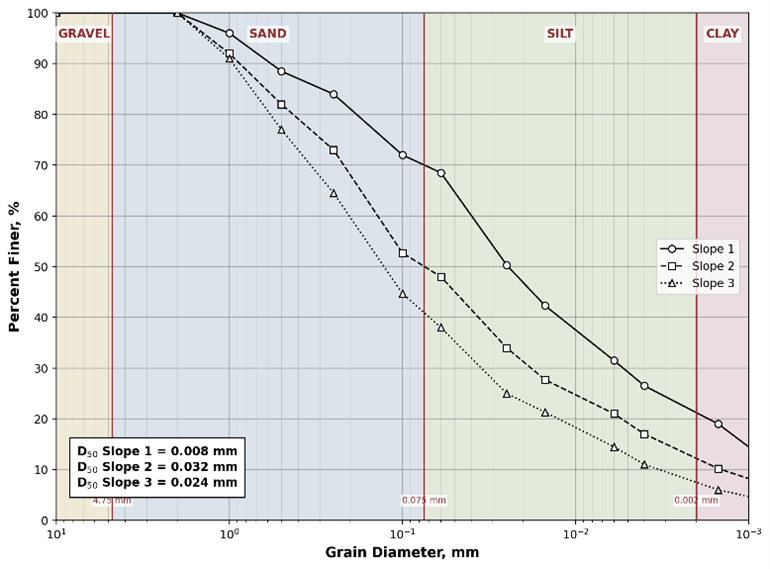
Sitinjau Lauik, a national road corridor in West Sumatra, Indonesia, is one of the most landslide-prone segments of the Bukit Barisan volcanic belt. This study assesses the geotechnical and seismic stability of three tropical residual soil slopes at this location by combining cone penetration testing (CPT), laboratory index testing, consolidated-drained direct shear testing (DST), and Morgenstern–Price limit-equilibrium analysis under static and pseudo-static seismic loading. CPT profiles revealed a weak layer (qc = 0.4–0.6 MPa) at 1.2–2.8 m depth in Slope 1. This slope also has a high plasticity index (PI = 39.7%), a high void ratio (e = 1.50), and a low dry density (γd = 10.06 kN/m³), resulting in lower shear-strength parameters (c' = 17.8 kPa, φ' = 19.2°) than Slopes 2 and 3 (PI < 10%). Static factors of safety (FS) were 1.08, 1.54, and 1.49 for Slopes 1, 2, and 3, respectively. A pseudo-static coefficient of kh = 0.15, consistent with regional peak ground acceleration zoning, reduced the FS values to 0.77, 1.23, and 1.17, making Slope 1 unstable during earthquakes. At kh = 0.20, none of the slopes met the minimum FS of 1.1 required by the Indonesian National Standard (SNI) 8460:2017. High plasticity, a high void ratio, and low CPT resistance distinguished the critical Slope 1 from the other slopes. Because only three slopes were examined, these findings are site-specific; nevertheless, they provide a basis for prioritizing slope remediation and early warning along this corridor.
Downloads
Downloads
Published
License
Copyright (c) 2026 Okri Asfino Putra, Hamdeni Medriosa, Fajar Nugroho, Muhammad Hamzah Fansuri, Pungky Dharma Saputra, Anasya Arsita Laksmi

This work is licensed under a Creative Commons Attribution 4.0 International License.
Authors are permitted and encouraged to post their work online (e.g., in institutional repositories or on their website, social networking sites, etc).


 © SET Journal