
Hybrid Edge-Blockchain Framework for Secure Healthcare Big Data Processing
DOI:
https://doi.org/10.54327/set2027/v7.i1.406Keywords:
Apache Kafka, edge computing, Internet of Medical Things (IoMT), IPFS, permissioned blockchainAbstract
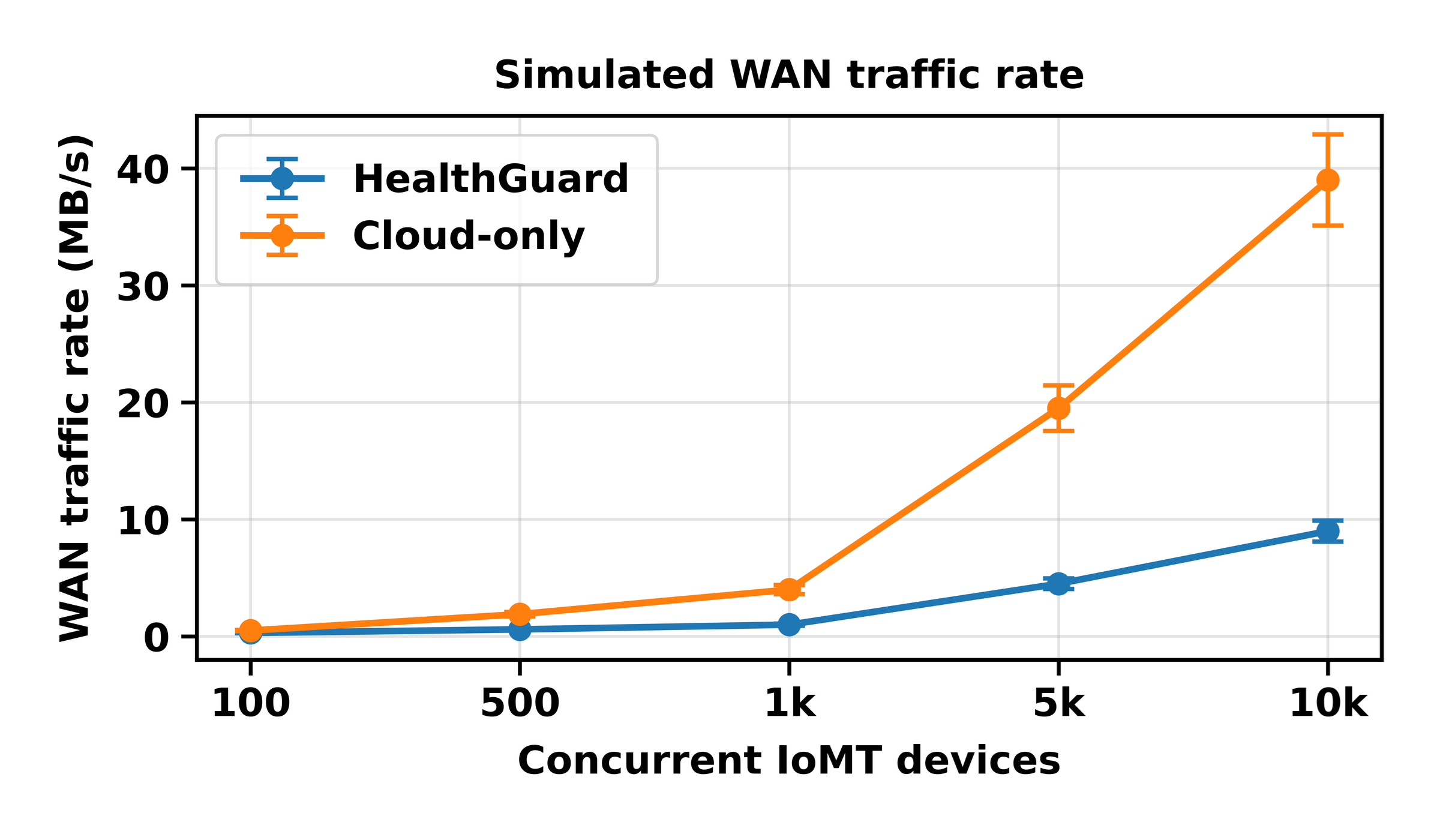
The growing number of Internet of Medical Things (IoMT) devices and 5G/6G connections is putting pressure on centralized cloud healthcare systems. These systems face wide-area-network delay, high bandwidth use, single points of failure, and weak auditable governance of sensitive data. Existing hybrid solutions often focus on only one issue, such as telemetry streaming, secure learning, or off-chain storage. They may also perform poorly with large payloads and give limited attention to emergency access and sensor-to-ledger provenance. This paper presents HealthGuard, a novel hybrid edge-blockchain architecture. It separates latency-sensitive telemetry (velocity) from high-volume medical objects (volume) across five layers. The main contributions are fourfold: an edge-AI triage and feature-extraction pipeline; decoupled velocity/volume data paths; a smart-contract break-glass emergency override with immutable auditing; and device-signature verification at the edge before oracle submission. Critical events are triaged locally. Apache Kafka supports asynchronous stream transport. Encrypted imaging objects are stored off-chain on InterPlanetary File System (IPFS). A permissioned blockchain records identity, authorization, and audit metadata only. The framework was compared with a matched cloud-only baseline. The simulation included 100–10,000 concurrent devices, each generating four events/s. Paired statistical testing with Holm correction was used. HealthGuard reduced mean end-to-end latency from 46.6–140.8 ms to 35.4–115.1 ms. This represents an 18.2–24.9% relative reduction and is statistically significant at all loads. It also reduced simulated Wide Area Network (WAN) traffic by 77%, exceeding the 60% design target. Delivery success remained above 0.97 at 40,000 offered events/s. These simulation-based results, not physical-deployment evidence, show that edge triage with permissioned auditing can support scalable and secure healthcare Big Data processing.
Downloads
Downloads
Published
Issue
Section
Categories
License
Copyright (c) 2026 Ahmed N Hassan, Tarfa Hamed, Omar Abdulmunem Ibrahim Aldabbagh, Abdullah S. Sulaiman, Yue Cao, Omprakash Kaiwartya

This work is licensed under a Creative Commons Attribution 4.0 International License.
Authors are permitted and encouraged to post their work online (e.g., in institutional repositories or on their website, social networking sites, etc).


 © SET Journal